> For the complete documentation index, see [llms.txt](https://docs.bcbi.brown.edu/codiac-for-health/llms.txt). Markdown versions of documentation pages are available by appending `.md` to page URLs; this page is available as [Markdown](https://docs.bcbi.brown.edu/codiac-for-health/foundations/biomedical-informatics.md).
# Biomedical Informatics
*Biomedical informatics is a trans-disciplinary field that “studies and pursues the effective uses of biomedical data, information, and knowledge for scientific inquiry, problem solving and decision making, motivated by efforts to improve human health.”* \[[1](#references)]
The origins of biomedical informatics date back to the 1950s. While the name and definition of the field have evolved with advancements in data, technology, and knowledge, the motivations have remained the same: **to advance biomedical discovery and healthcare delivery**. This discipline broadly involves the development, application, and evaluation of approaches for generating, organizing, managing, analyzing, and sharing data to support clinical care, patient engagement, biomedical research, quality and safety, education, and public health. These approaches are often adapted and integrated from disciplines such as applied mathematics, biostatistics, computer science, cognitive science, data science, implementation science, library and information science, and management science.
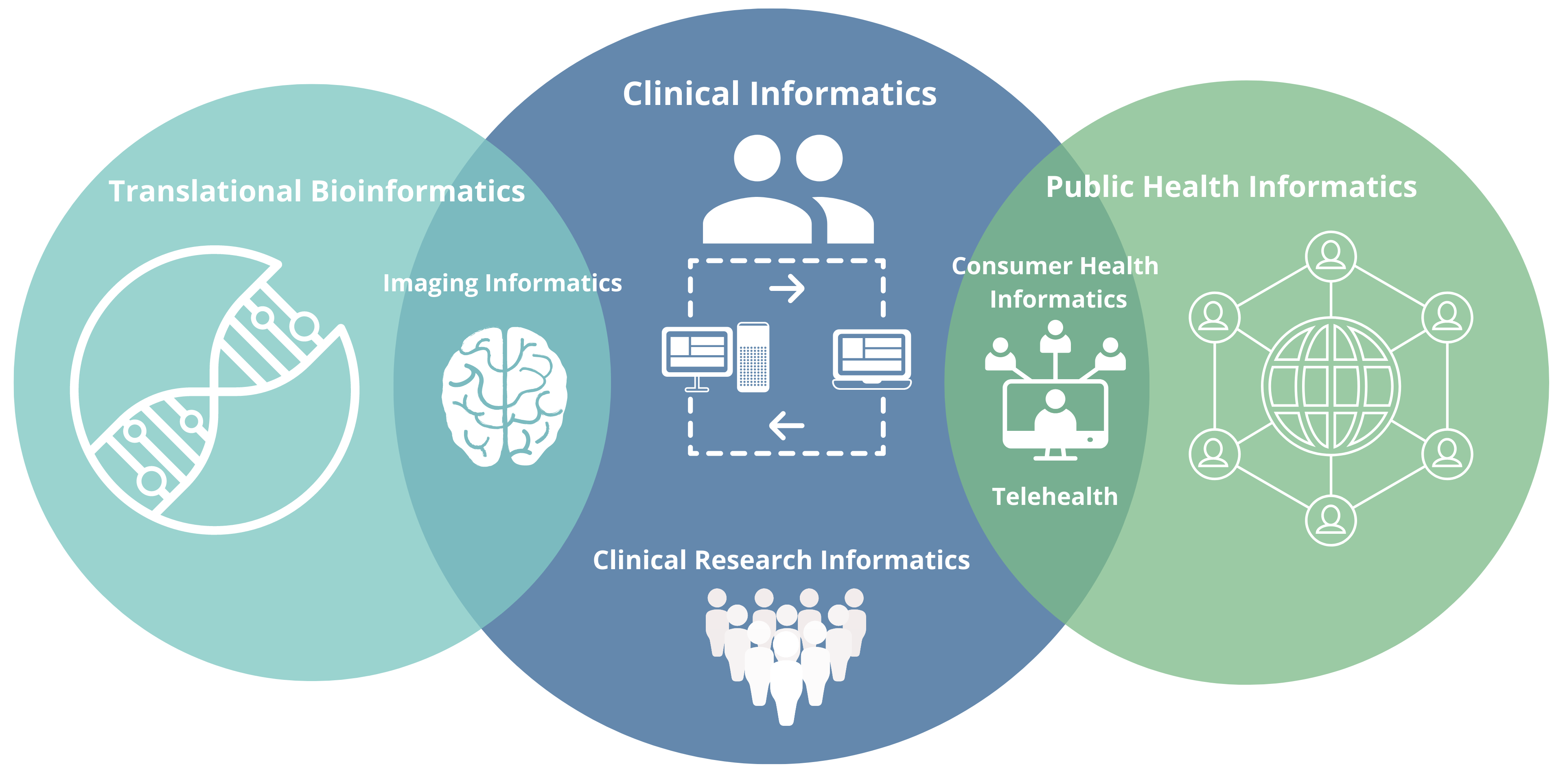
There are many sub-disciplines of biomedical informatics such as **health informatics** that encompasses \[[2](#references),[3](#references)]:
* *Clinical Research Informatics*: Development of approaches for enabling the discovery, management, and evaluation of new health knowledge;
* *Clinical Informatics*: Development and application of techniques to improve health care delivery services (clinical informatics is a subspecialty of the American Board of Medical Specialties);
* *Consumer Health Informatics*: Development of information structures and approaches for supporting patient-centric health care needs; and,
* *Public Health Informatics*: Development of methodologies for supporting public health needs, including surveillance, prevention, preparedness, and health promotion.
The Data-Information-Knowledge-Wisdom (DIKW) model, established in 1989, serves as a fundamental framework in biomedical informatics and its sub-discipline of health informatics, illustrating the progression from raw data to meaningful knowledge and actionable wisdom within a healthcare context \[[4-6](#references)]. Guided by the DIKW model, health informaticians use transdisciplinary approaches and collaborations to advance [**Learning Health Systems**](https://docs.bcbi.brown.edu/codiac-for-health/foundations/learning-health-systems) and [**Artificial Intelligence in Health**](https://docs.bcbi.brown.edu/codiac-for-health/foundations/artificial-intelligence-in-health).
## References
1. Kulikowski CA, Shortliffe EH, Currie LM, Elkin PL, Hunter LE, Johnson TR, Kalet IJ, Lenert LA, Musen MA, Ozbolt JG, Smith JW, Tarczy-Hornoch PZ, Williamson JJ. [**AMIA Board white paper: definition of biomedical informatics and specification of core competencies for graduate education in the discipline**](https://pubmed.ncbi.nlm.nih.gov/22683918/). J Am Med Inform Assoc. 2012 Nov-Dec;19(6):931-8. doi: 10.1136/amiajnl-2012-001053. Epub 2012 Jun 8. PMID: 22683918; PMCID: PMC3534470.
2. Chen ES, Sarkar IN. [**\*informatics: Identifying and Tracking Informatics Sub-Discipline Terms in the Literature**](https://pubmed.ncbi.nlm.nih.gov/25998007/). Methods Inf Med. 2015;54(6):530-9. doi: 10.3414/ME14-01-0088. Epub 2015 May 22. PMID: 25998007.
3. American Medical Informatics Association (AMIA) - [**What is Informatics?**](https://www.amia.org/about-amia/why-informatics/informatics-research-and-practice)
4. Ackoff RL. **From data to wisdom**. Journal of applied systems analysis. 1989;16(1):3-9.
5. Fayyad U, Piatetsky-Shapiro G, Smyth P. **From Data Mining to Knowledge Discovery in Databases**. AIMag \[Internet]. 1996Mar.15 \[cited 2024Nov.5];17(3):37.
6. Chen ES, Sarkar IN. [**Mining the electronic health record for disease knowledge**](https://pubmed.ncbi.nlm.nih.gov/24788272/). Methods Mol Biol. 2014;1159:269-86. doi: 10.1007/978-1-4939-0709-0\_15. PMID: 24788272.
## Resources
### Books
* Shortliffe EH, Cimino JJ, Chiang M, editors. **Biomedical informatics: computer applications in health care and biomedicine**. 5th ed. Springer; 2021.
* Sarkar IN, editor. **Methods in Biomedical Informatics**. Academic Press; 2014. ISBN: 9780124016781.
* Hersh W, editor. **Health Informatics: Practical Guide**. 8th ed. 2022.
* Collen M, Ball M, editors. **The History of Medical Informatics in the United States**. London: Springer; 2015.
### Articles
* Sarkar IN. [**Biomedical informatics and translational medicine**](https://pubmed.ncbi.nlm.nih.gov/20187952/). J Transl Med. 2010 Feb 26;8:22. doi: 10.1186/1479-5876-8-22. PMID: 20187952; PMCID: PMC2837642.
* Bernstam EV, Smith JW, Johnson TR. [**What is biomedical informatics?**](https://pubmed.ncbi.nlm.nih.gov/19683067/) J Biomed Inform. 2010 Feb;43(1):104-10. doi: 10.1016/j.jbi.2009.08.006. Epub 2009 Aug 13. PMID: 19683067; PMCID: PMC2814957.
### Links
* [What is Biomedical and Health Informatics?](https://dmice.ohsu.edu/hersh/whatis/)
* [Yearbook of Medical Informatics](https://www.thieme-connect.com/products/ejournals/journal/10.1055/s-00034612)
---
# Agent Instructions
This documentation is published with GitBook. GitBook is the documentation platform designed so that both humans and AI agents can read, navigate, and reason over technical content effectively. Learn more at gitbook.com.
## Querying This Documentation
If you need additional information that is not directly available in this page, you can query the documentation by asking a question.
Perform an HTTP GET request on the following URL with the `ask` and `goal` query parameters:
```
GET https://docs.bcbi.brown.edu/codiac-for-health/foundations/biomedical-informatics.md?ask=&goal=
```
`ask` is the immediate question: it should be specific, self-contained, and written in natural language.
`goal` is what the user is ultimately trying to achieve, the reason they need the answer. Sharing it helps GitBook give you a better, more relevant answer. A goal is most helpful when it describes the outcome the user wants rather than restating the question. For example, with `ask=how do I create an API token`, a goal like `automate deployments from our CI pipeline` lets GitBook tailor the answer to that use case.
The response will contain a direct answer to the question and relevant excerpts and sources from the documentation.
Use this mechanism when the answer is not explicitly present in the current page, you need clarification or additional context, or you want to retrieve related documentation sections.